In short: LLMs and agents are excellent at language, judgment calls and orchestration, but poor at the millisecond, high-volume numeric decisions that make money in lead generation. The winning architecture keeps classical models and optimizers in the decision path and puts agents around them: reading contracts, talking to borrowers, watching operations and explaining results, with humans approving anything consequential.
Every lead generation executive is now being pitched "AI agents." Some of those pitches promise an agent that will price your leads, route your traffic and manage your buyers on its own. Others dismiss LLMs as chatbots irrelevant to a business run on ping-post auctions.
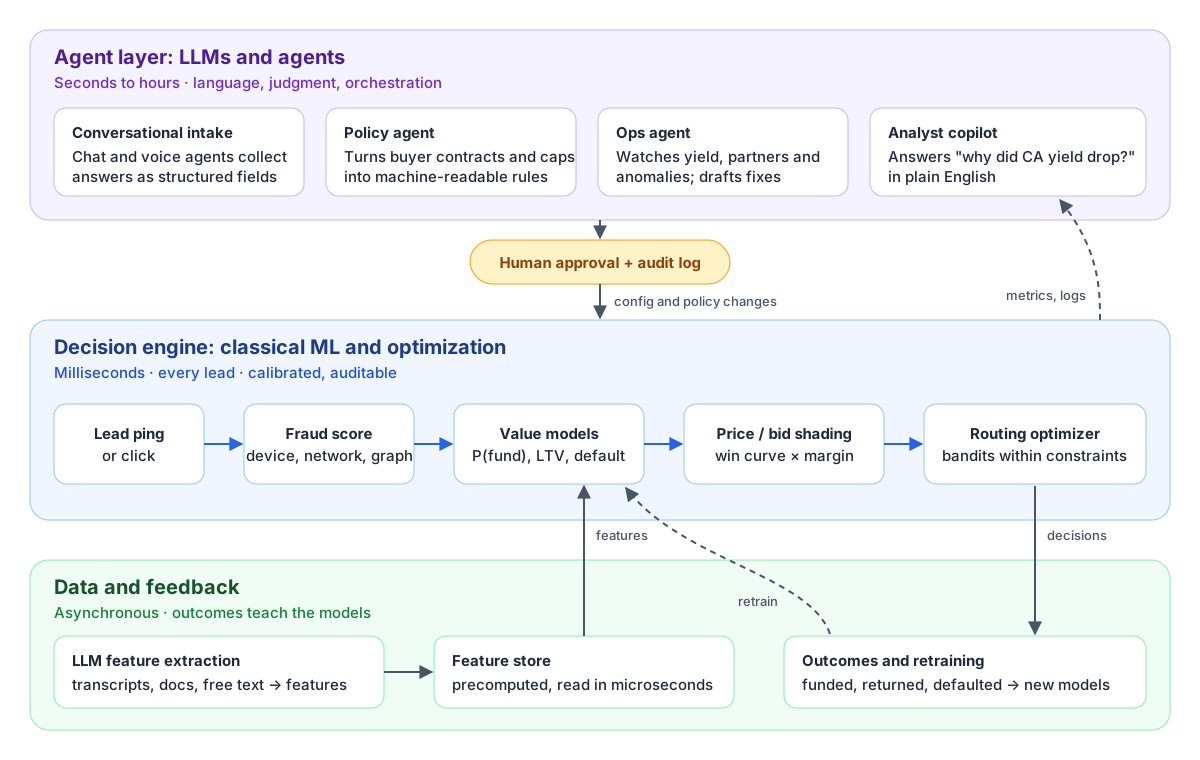
Both are wrong. After years of building decision systems for lead marketplaces, and now LLM systems alongside them, our view is simple: LLMs read, write and reason; models price, route and bid; agents connect the two under guardrails. This article maps which decisions belong where.
Two Kinds of AI, Two Kinds of Decisions
Lead businesses make two very different kinds of decisions.
High-frequency numeric decisions happen millions of times a day, in tens of milliseconds, at a cost that has to round to zero. Examples: what to bid on this click, what price to quote this buyer, which lender gets this lead, whether this lead is fraud. These decisions run on structured data, have measurable outcomes and must be consistent and auditable.
Low-frequency language and judgment tasks happen dozens or thousands of times a day, can take seconds or minutes, and involve messy, unstructured inputs. Examples: interpreting a buyer's new filter email, qualifying a borrower in conversation, investigating why yield dropped in Texas, reviewing an affiliate's landing page for compliance, drafting the weekly partner report.
Classical machine learning (gradient boosting, bandits, reinforcement learning, auction theory) dominates the first category. On tabular data, tree-based models still outperform deep learning, and they do it in microseconds. LLMs dominate the second category, where until recently the only option was a person.
The Decision Map
| Decision | Latency budget | Right tool | LLM role |
|---|---|---|---|
| Fraud screening on a ping | < 50ms | ML classifier on device, network, velocity signals | Offline: find templated text across applications |
| Lead valuation and pricing | < 100ms | Calibrated gradient boosting + price optimizer | Explain price moves to account managers |
| Bid amount in an auction | < 100ms | Value model + bid shading | Summarize auction logs and win-rate shifts |
| Routing and offer order | < 200ms | Expected-value ranking + bandits | Turn buyer contracts into constraints |
| Borrower qualification | Seconds | Conversational agent + scoring model | Ask questions, extract structured answers |
| Partner and campaign monitoring | Minutes to hours | Agent with tools and alerts | Primary actor, with human approval |
| Creative and copy | Days | LLM generation + bandit testing | Generate variants within compliance rules |
| Performance analysis | Hours | Analyst copilot over your warehouse | Primary actor |
The pattern: the faster and more frequent the decision, the less the LLM should be in it.
Where Agents Create Real Value
1. Policy and contract management. Buyer filters, caps, exclusivity terms and state restrictions arrive as emails, PDFs and spreadsheets. Encoding them by hand is slow and error-prone, and every mistake misroutes leads. An agent can read the source document, propose the machine-readable constraint, flag conflicts with existing rules and queue the change for approval. That keeps the routing optimizer running on current rules.
2. Conversational intake. Chat and voice agents can replace long forms with a short conversation, collecting richer information ("three cards, about $18k, one payment behind") as structured fields for the scoring model. See Conversational Lead Qualification.
3. Operations monitoring. An ops agent can watch yield by segment, buyer acceptance rates, partner traffic quality and fraud flags overnight. When something breaks, it investigates and drafts a fix instead of just raising an alarm. See The Autonomous Lead Desk.
4. Unstructured data as features. LLMs turn call transcripts, chat logs, documents and free-text fields into features the numeric models can use, computed asynchronously so they never slow an auction. See Turning Calls and Chats into Model Features.
5. Explanation and analysis. "Why did lead 4471 go to Buyer B?" and "What changed in California debt leads this week?" become questions anyone can ask in plain English, answered from logs and model explanations.
Where LLMs Don't Belong (Yet)
In the auction hot path. A frontier-model call takes hundreds of milliseconds to seconds and costs orders of magnitude more than a tree-model inference. Inside a 100ms timeout, that is disqualifying. If an LLM-derived signal is valuable in real time, precompute it or distill it into a small model. See Latency is Revenue.
As the source of a price or a risk score. LLM outputs are hard to calibrate, can change when the prompt or model version changes, and cannot easily produce the stable reason codes lenders need for adverse-action notices. Use them to inform models, not to replace them. See LLM Model Risk and Compliance in Lending.
As an unsupervised actor with money on the line. An agent that can change bids or buyer caps without approval is one bad inference away from an expensive day. Start agents in "propose" mode, measure how often their proposals are right, and grant autonomy one narrow permission at a time.
Design Principles for an Agentic Lead Stack
- Models are tools, agents are callers. Expose your pricing, routing and scoring models as tools an agent can query, for example through the Model Context Protocol, rather than asking the agent to reproduce them.
- Start with workflows, not autonomy. Anthropic's guidance on building effective agents recommends the simplest pattern that works. A fixed workflow with one LLM step often beats an open-ended agent.
- Gate consequential actions. Anything that changes money flow, partner terms or customer communications passes through human approval and lands in an audit log.
- Evaluate continuously. Every prompt and agent needs a test set. Measure agents on business outcomes, such as proposals accepted and incidents caught, not just on fluency.
- Optimize for incrementality. An agent that sends more mail or buys more leads will always look busy. Give it the same incremental-profit objective as the models.
The Bottom Line
Agentic AI doesn't replace the algorithmic core of a lead business. It makes that core easier to run, easier to question and faster to adapt. The companies that win will combine both: algorithms instead of heuristics in the decision path, and agents instead of manual toil around it.
Frequently Asked Questions
Can an LLM price or route leads in real time?
Not well. Real-time pricing and routing need millisecond responses, calibrated probabilities and consistent, auditable outputs, which tabular ML models provide at a fraction of the cost. LLMs are better used around those models.
What are AI agents good for in lead generation?
Reading and encoding buyer contracts and filters, qualifying borrowers in conversation, monitoring partners and yield, turning unstructured text into model features, generating creative, and explaining performance in plain English.
How do you keep AI agents safe in a lead business?
Start them in propose-only mode, route consequential actions through human approval, log every action, test prompts against evaluation sets, and expand permissions only where measured accuracy justifies it.
What is the difference between an AI agent and a machine learning model?
A machine learning model maps inputs to a prediction, such as a funding probability. An agent uses an LLM to plan and take multi-step actions with tools, which can include calling those models.
Want an agent layer that makes your decision engine smarter, not riskier? Contact Plato AI to see how we combine low-latency optimization models with LLM agents built for lead marketplaces.